11 januari 2016 · 13:50 · door Daniël Willaeys
Fourberry - Crandallberry
0 beelden 1 reacties
Fourberry: More than just a new fruit
Posted by Graham Rice (RHS in Engeland) on 12 Nov 2011
The blackcurrants, redcurrants, whitecurrants and gooseberries that we grow in our gardens are all derived from different wild species of Ribes. But, in all, there are around 150 different wild Ribes and others are also well worth growing including, of course, the flowering currant, Ribes sanguineum.
Now another species comes to the fore, R. odoratum (usually grown in gardens as R. aureum) and long prized for its attractive fragrant spring flowers. Two new varieties are being launched this autumn, ‘Black Gem’ and ‘Black Pearl’, both selected from several thousand seedlings for their combination of colorful flowers, fragrance, autumn foliage colour and, of course, high quality fruit. These four features give them the common name of Fourberry.
Developed in Switzerland by a family fruit nursery that began as long ago as 1889, their Lubera brand specialises in new fruit varieties of all kinds. Their RedLove apple was launched last year.
In April and early May, the distinctive yellow flowers of Fourberries hang along the length of the previous year’s branches in long strings. Each has a distinctive red ring around the centre of the flower and a delightful fragrance. In summer the black berries ripen, they can be eaten fresh or used for juice or in jam. Then, finally, in autumn the foliage turns vivid red. In today’s smaller gardens, any plant that brings us four separate features at different times of year by is especially valuable.
Both varieties reach 1.2-1.5m/4-5ft, ‘Black Gem’ has slightly smaller berries and ripens from the end of July to mid August while ‘Black Pearl, with its larger berries, ripens earlier, from mid July into early August. Grow both for the longest season.
You can buy Fourberry ‘Black Gem’ from Suttons, and you can buy Fourberry ‘Black Pearl from Dobies.
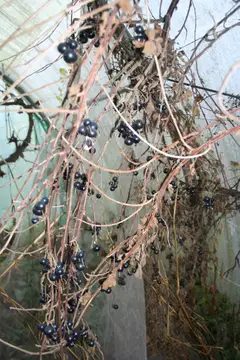
Twintig jaar terug verwierf ik – via Peter Bauwens- de Crandallbes. In de USA heeft men het blijkbaar over crandallberry en in GB over fourberry.
Crandallbes
Family: Grossulariaceae Genus: ribes Species: ribes odoratum (known as spicebush or clove currant)
General form is upright, making a bush that is more vertical than drooping. Leaves are more finely divided than most other currants, deviating a bit from the maple leaf resemblance. This is a very attractive plant, the foliage becoming a brilliant red come fall and retaining those leaves better than many other ribes. The blooms are also distinct, forming a bright yellow trumpet shaped flower that stands out from rich green bush. Most others in this genus have nearly invisible bloom and low fragrance, but not this one, making for an ornamental and aromatic addition to the landscape. The names “spicebush” and “clove currant” were given to oderatum for the character of the flowers’ odor. Flowering lasts two weeks.
The overall growth is : height: 3 to 7 feet, spread: 3 to 5 feet. It is known to tolerate heat a bit better than other ribes. It has a reported resistance to white pine blister rust and to powdery mildew. It is immune to cane blight.
Pollination is a non-issue with most ribes since most are self pollinating. The skinny on Crandall is a bit less clear. Many references state that odoratum species are a dioecious lot, and furthermore many lump Crandall in with the wild species. There are conflicting reports from nurseries and growers about this. Nurseries and orchards (us included) would find it hard to come to terms on this issue due to a wide range of suitable pollinators from other individuals and species. There are growers who report good cropping with a single Crandall. What is escaping the discussion is that no Crandalls have ever been sold as sexed plants (see Research pages for more on dioecious plants), so the whole issue seems moot. Also, all named varieties are clones, which of course would not yield both sexes from a single plant, which is what named varieties are. All the Crandalls growing in our orchard are a single clone, and all produce fruit. The conclusion? We would suggest growing it in company with other ribes, since we like to sell more plants (wink), but you will probably be fine with one.
Crandall is one of the so-called clove currants (ribes odoratum) which are native in the US and common from Minnesota down through Missouri and to Texas. The species in general are very winter hardy, and Crandall in particular has survived well in North Dakota plantings. This heirloom variety was introduced in 1888.
Fruit ripens unevenly. Green picked fruits reportedly will ripen. These berries will be larger than other currants, up to ¾ an inch, making it more the size of a gooseberry or grape. These are quite different in taste than true black currants. The Crandall is far sweeter, and lacks the distinct musky flavor of ribes nigrum. It is a much better candidate for fresh eating, but the less pronounced taste will not compare with traditional black currants in the culinary realm.
Read more about currants in the Research section…
Additional Information
|
Botanical Name |
ribes odoratum |
|
Common Name |
currant |
|
Cold Hardiness |
Cold Hardy |
|
Heirloom Status |
No |
|
Fruit Uses |
All Purpose |
|
Storage |
Fair |
|
Harvest Season |
Summer, Late Summer |
|
Bloom Time |
self pollinating |
|
Fruit Qualities |
sweet/tart distinctive |
|
Tree/Plant Qualities |
moderate vigor |
|
Planting Location |
Partial Shade |
Fourberry® Orangesse®
Dit is al een nieuw ontwikkelde oranje variëteit. Vergelijk met Pink Lemonade bij de blauwbessen.